The other day, at Wonder rehearsal, I passed by Garrett McNally, who plays Auggie, and he said, “Could you write something about the making of this musical?” I thought about that for two seconds and said, “Yes, of course!”
So let me go back in time.
❦
I first encountered the book Wonder when I had three kids under the age of four and a face that was paralyzed on the left side with Bell’s palsy after I gave birth to my twins. People had trouble reading my facial expressions; even my attempts at smiles looked like grimaces. Most people recover in three months from Bell’s palsy; however, mine was an ongoing chronic condition.
I had spent those early mothering years in constant physical motion, taking care of three children, while emotionally and facially, I felt immobilized. All I wanted was to do was smile at my babies. My older sister recommended Wonder to me, saying her kids had read it in school and that she herself had found it very moving. I read Wonder, cried and felt seen, even though my experience was very different from Auggie’s.
As many of you already know, the book Wonder follows Auggie, who was born with a craniofacial difference, and his family, as they navigate Auggie’s first year going to school after years of being homeschooled.
❦
A decade passes, in which I make a lot of theatre and go to a lot of doctor’s appointments with specialists (with varying bedside manners) to try to figure out why my face (or rather, my cranial nerve) is not healing. None of them know. When I go to the theatre, I notice how, by and large, it seems to be a platform for the healthy and symmetrical among us.
I dream of making a theatre piece that makes more room for people with asymmetries of all kinds, a piece that makes asymmetry visible.
❦
I am on an airplane, coming back from the West Coast, where I was working on a play, to New York City. I’m watching Wonder on the plane. I start sobbing. A flight attendant puts her hand gently on my shoulder and asks if there is anything wrong. “No,” I say, “I’m just watching Wonder!”
❦
Two years ago, I get a call out of the blue from producer Jill Furman, who asks if I might be interested in working on the musical Wonder. She has read my book Smile, a memoir of mothering, theatremaking, and facial paralysis, and she wonders if the musical might be a fit for me. I say that I loved the book and the movie, and I would love to meet the musicians working on the team. A Zoom is scheduled with the two brilliant minds Chad King and Ian Axel, who comprise the band A Great Big World, and the wise, compassionate director Taibi Magar. We have a meeting of the minds. I love how A Great Big World’s music is as open-hearted as it is playful and never seems to leave the world of childhood behind, while allowing for grown-up emotions.
I love being around these people. Which is important when you work on a musical, because you are with these people a lot. Possibly for years. And we are off to the races.
❦
The Wonder team has already been searching for an actor to play Auggie for three years, creating a national and international search for young actors with a facial difference. In March of 2022, they received a video from Quincy, California. Garrett McNally has sent in an utterly charming video of himself singing an Elton John song. He is wearing a shirt with a drawing of planet Earth on it, is in a sunny room with windows looking out into pine trees. He is clearly funny and charismatic, playful, and a good mover. He’s in.
The team needs a second Auggie for coverage (it’s a big, exhausting role, and if Garrett had the flu, he’d need an understudy). Again, the team does a national search, through organizations like myFace, and helped enormously by Dina Zuckerberg. (MyFace was founded 70 years ago to give support and advocacy to individuals and families impacted by facial difference.) The casting team gets a video from 12-year-old Max Voehl and flies him and his family to New York for an audition. He learns the song “Stare” from the musical and sings it beautifully. He and his mom tell us how much the story of Wonder has meant to them, how much Auggie’s story resonated. Max also gives the team a box of chocolates. He’s in! (It wasn’t the box of chocolates, but I promise you that we do like chocolate behind the music table at tech rehearsal. Lots of chocolate.)
❦
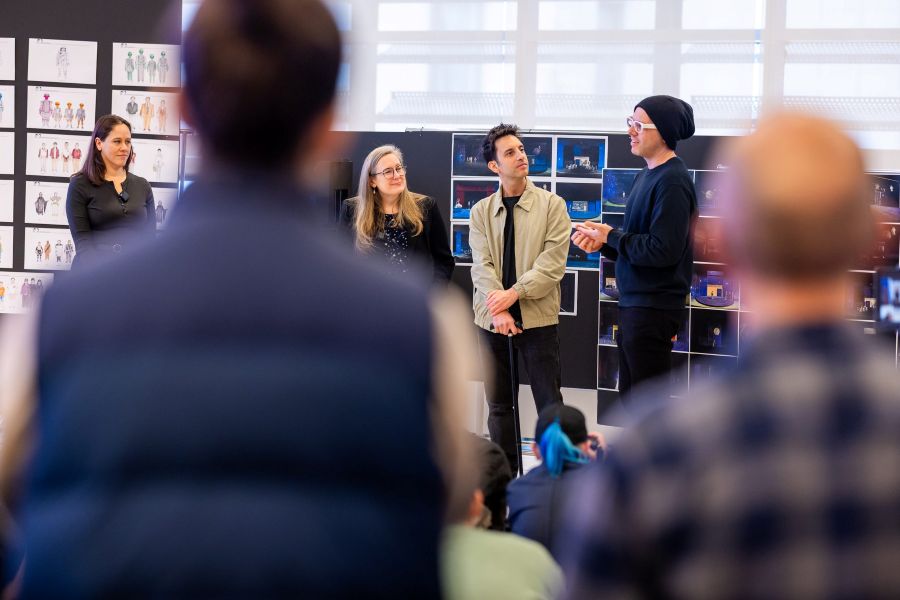
While we are searching for our cast, we are also busy at work on the material. A Great Big World has already composed most of the music for the show, and it’s my job to work on dialogue and structure, and to see if there might be any moments missing to emotionally mark with a song. I recently described the job of a book writer for a musical as being an invisible floating bridge between departments. You don’t want the dialogue to be too visible. Unlike in Hamlet, where “the play is the thing,” in a musical, the music is the thing, but the music must be deeply grounded in story, character, and emotional reality. That’s quite a needle to thread.
I come up with a new character who is an imaginary friend/doppelganger for Auggie who can play in space when both of their helmets are on, and who can offer Auggie a playful friendship before he meets Jack. For a while we call him quite simply Space Auggie, then we call him Moon Boy. For those of you who haven’t read Wonder, space is a big theme, and Auggie is deeply interested in the science of space, as well as space as a landscape in Minecraft and in his own imagination.
❦
It’s finally Day One of our first workshop to hear what we’ve made so far. Matthew S. Joffe, our wonderful and insightful consultant on Wonder, leads workshops with our cast (and the innumerable people it takes to make a musical) on disability and inclusion. Matthew is one of the wisest people I’ve had the good fortune to meet. He’s been involved in theatre as a performer and audience member, as well as heading student services at La Guardia Community College, and he has Moebius syndrome. On Day One, Matthew asks our group a very simple question: What is something you’d like the group to know about you that might not be visible to them?
This apparently simple and disarming question elicits emotional responses from the whole group, actors and creative team alike. Chad King, one half of the composing team, talks about having M.S., and what it’s been like to scale back on performing because of how M.S. affects his voice, and how weakness on the left side of his arm impacts his guitar playing. He also talks about his embarrassment when he started walking with a cane, and how the cane later came to be a source of power and pride. I talk about having partially recovered from Bell’s palsy, and how I always worry on the first day of meeting a group that people will think I’m not friendly, because I can’t flash people a big Midwestern grin with teeth (I’m from Illinois originally, land of big smilers). Taibi talks about being deaf in one ear, and how she’s learned to listen more acutely with the other. Nadia DiGiallonardo, the music director and arranger, talks about having strabismus, which means that one of her eyes doesn’t align to look at the same point as the other eye, and how it feels when people don’t know whether she’s looking at them. Katie Spelman, the choreographer, talks about having shattered the navicular bone in her left foot 15 years ago, and the devastation of being told she’d never dance again. Ian Axel, the other half of the A Great Big World duo, talked of the invisible struggles of having OCD.
The fact that most of our creative team grapple with visible or invisible challenges might have come as a surprise to all of us—we weren’t chosen specifically because of the physical or non-physical hurdles we’d faced—but it’s possible that grappling with them drew us to the material.
Or, more tellingly, we spend so much time in the world of performance trying to lead with some presentation of healthy and robust that people have no idea what our invisible struggles are. We might not have told the group about what we were facing if Matthew had not had the grace to ask. For me, it’s a good lesson on how to lead a rehearsal room, or a classroom, and how to set the tone for people who will be asked to be vulnerable in a community.
❦
In rehearsals, I am deeply moved by how quickly this company of kids (and grown-ups) becomes an ensemble. The kids eat together, play together, and never seem to want to leave at the end of the day. The acting and singing coaches (Kate Wilson, Najah Muhammad, and Chris York) who were brought in are formidable, doing voice work, gestural work, and the beautiful work of teaching kids to play. At one point, during a theatre game, I volunteer to play Auggie’s mom while the amazing Alison Luff is having a fitting. Kate gives us the instruction to sing our spoken lines instead of saying them, improvising a melody. This theatre game opens up the voice, and creates a sense of play and freedom in the saying of a line. I sing my lines robustly, badly, with great delight. I remember this theatre game from when I was a child, learning Viola Spolin games from Joyce Piven at the Piven theatre workshop. These kinds of games are what made me want to do theatre in the first place: a place of community, improvisation, play, and giving kids who haven’t been onstage before self-confidence in the art of practiced spontaneity—the great paradox of theatre.
❦
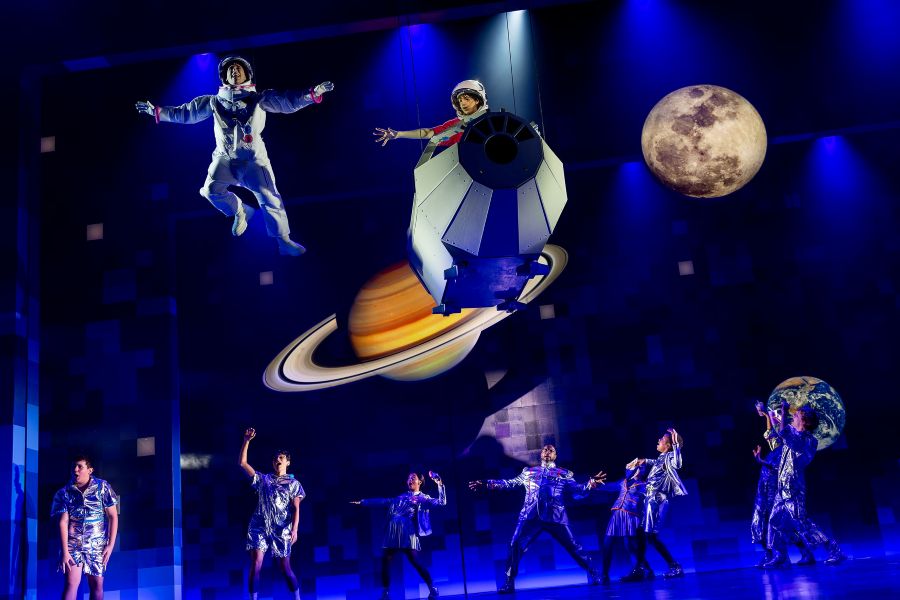
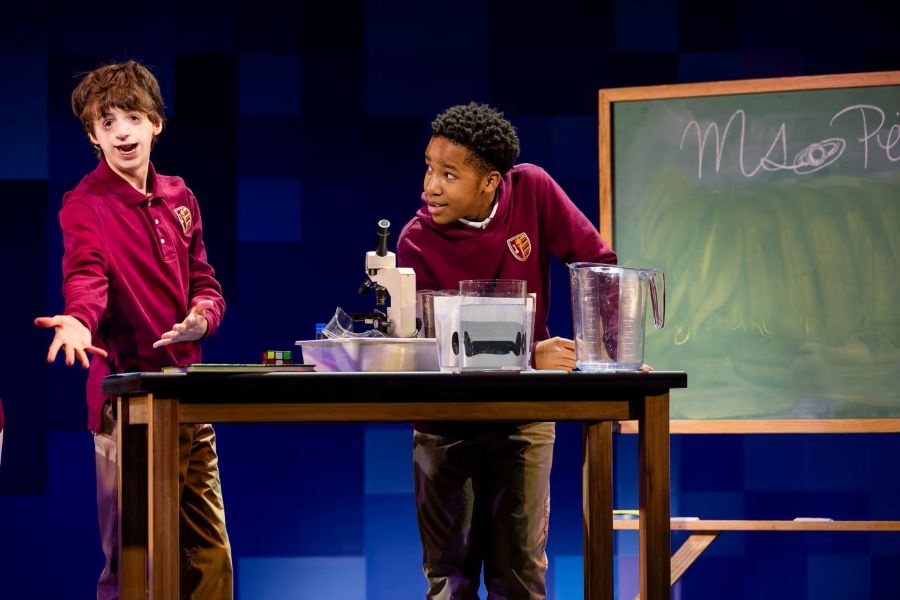
Hair, wig & make-up design: Rachael Geier.
(Photo by Hawver and Hall)
A year after the first workshop, we have done many, many rewrites, added songs, and cut songs. We have a full and wonderful cast, and we are now at day one of rehearsals for the ART premiere of the musical. There is much excitement. We begin rehearsals at a studio on 42nd Street. This is a kind group of actors, creators, and, crucially, crew and stage management. Again, either the material, with its “Choose Kind” mission, draws kind collaborators to it, or something about the way the rehearsal room is structured demands kindness.
Again, Matthew Joffe leads us in a discussion before rehearsals begin. He asks us: “How has this participating in this piece changed you so far?” I love that he begins with this question. I flash on a story about the Dalai Lama, who, when asked about whether a piece of art was good or not, said the value of a piece of art is how much it has changed the artist, and whether it has changed them for the better.
A young actor, Reese, who plays Julian (in the book, a bully), raises his hand. Reese is small and freckle-faced and in real life the furthest thing from a bully you could possibly imagine. He says, “What changed me is that—well, I have to say some horrible things in the play. And so I realized that my voice could do harm.” Reese’s voice starts to tremble, and he goes on, “So after I say these horrible things in the play, I go offstage, and I snap my fingers or make some kind of gesture to make it clear that once I’m off the stage, I’m not Julian anymore. But it makes me realize the power of your words, and how you use them, and how you might cause harm.” People around him nod.
We go around the room. I say that I hadn’t quite realized that the emotional impact of Bell’s palsy has kept following me around, despite time, physical therapy, and the catharsis of writing a book about it. When we had to have our pictures taken for Wonder, I suffered through it, and, when I looked at the outtakes, harshly identified many photos where I was laughing with my mouth open, making me look asymmetrical and askew. The choreographer at the time had said to me, after I made a harsh assessment of my own face, “Don’t be mean to my friend, Sarah.” I realized that I was in a trusted community, and the fact that this community made me laugh was much more important than how the pictures of me laughing looked.
Our director raises her hand. “When I first started Wonder,” Taibi says, “I wasn’t sure whether or not I wanted to have children. I was a busy director, and passionate about my work. In the process of making Wonder, I realized I definitely wanted to have children.” And she did. Her sweet 15-month-old just visited us in tech rehearsal, pointing at the lights, his eyes following his mother toward the stage.