Explicit tributes to or commemorations of our 16th president, Abraham Lincoln, have been notably scarce on the sprawling grounds of the New York City performing arts center ostensibly named in his honor (there’s actually some historical murk around the subject). Sam Waterston famously took on the role in a 1993 revival of Robert Sherwood’s Abe Lincoln in Illinois, but as far as I can tell, that’s the only time the Great Emancipator has made an appearance at Lincoln Center throughout its six-decade-plus history.
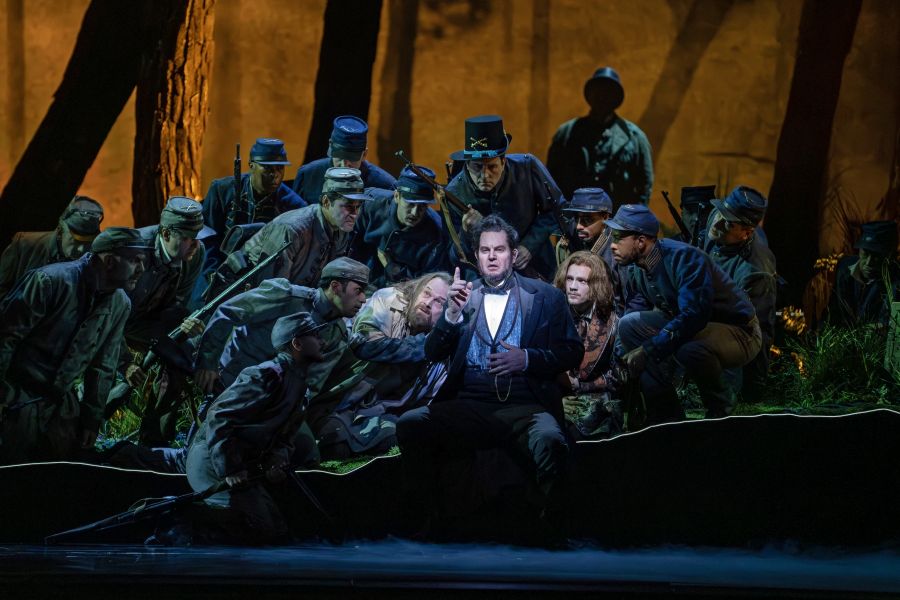
Until now: In Missy Mazzoli and Royce Vavrek’s transfixing, gloriously weird new opera based on George Saunders’s 2017 novel Lincoln in the Bardo—the first by a woman composer to premiere at the Metropolitan Opera, where it plays through Nov. 14—Honest Abe roves the stage, stove pipe and chin beard and all, as played with un-stuffy gravitas by the Swedish baritone Peter Mattei.
He is hardly alone. The Met stage, a sort of forested graveyard designed by Adam Rigg, teems with life—or rather, afterlife. Apart from Lincoln himself, the rest of the 30-person ensemble are playing either dead souls, including Lincoln’s son Willie, expired at age 11 of typhoid fever, all stranded in a purgatory-like nether state, or embodying aspects or outgrowths of the surreal setting: vine-like tendrils that encircle some victims, floating pig’s heads, a giant phallus. These last are largely the work of puppet designer James Ortiz, working closely with costume designer Montana Levi Blanco and choreographer Raja Feather Kelly.
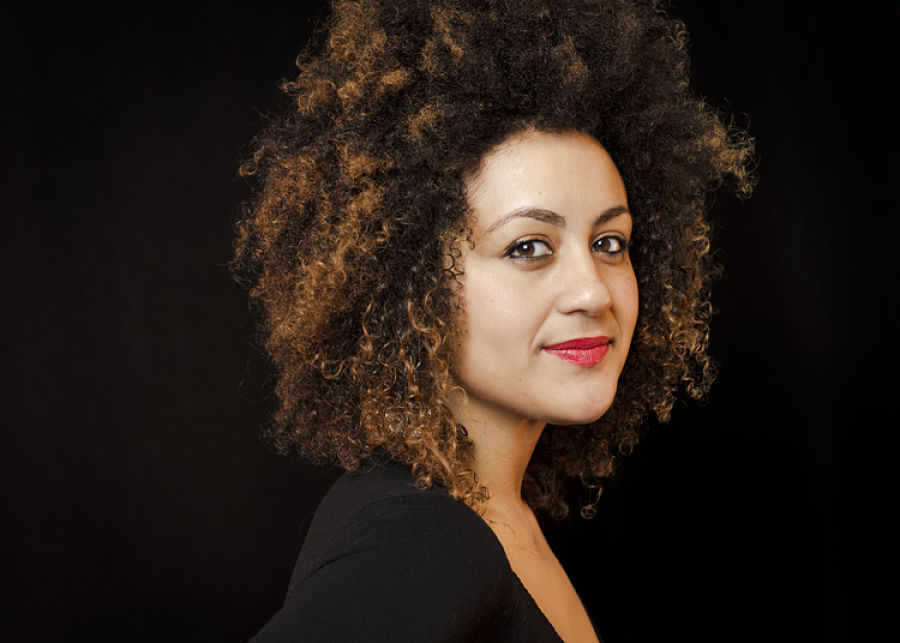
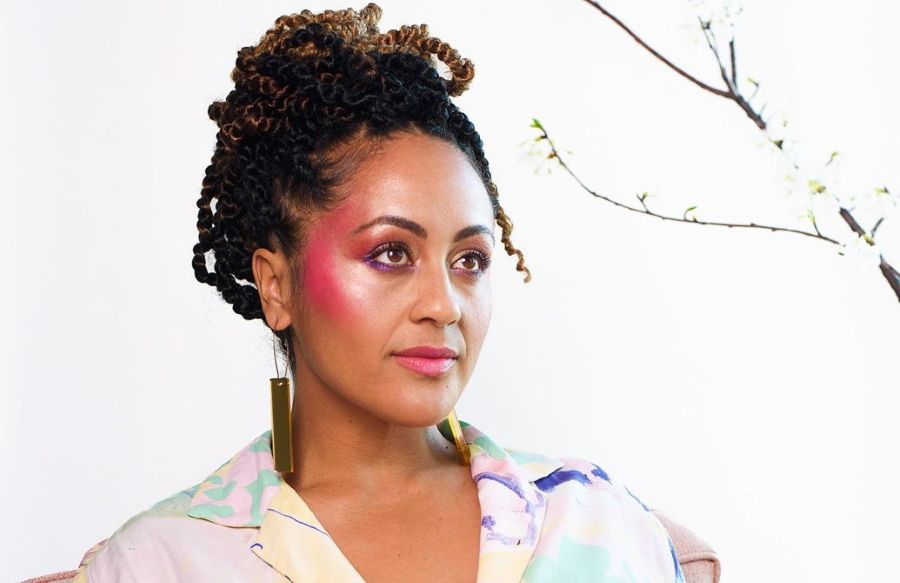
If those names, as well as that of co-lighting designer Yi Zhao, have a familiar ring for frequent theatregoers, that’s because they’ve all worked extensively on Broadway, Off-Broadway, and regionally, and in particular with director Lileana Blain-Cruz, a prolific theatre director with credits ranging from Soho Rep to New York Theatre Workshop to Theatre for a New Audience to Lincoln Center Theater, where she served for a time as a resident director. Blain-Cruz has been branching out into opera in recent years—2024’s El Niño at the Met, Mazzoli’s The Listeners at Chicago Lyric Opera last year, Faust at Opera Omaha in 2019—and bringing along her colleagues as much as possible.
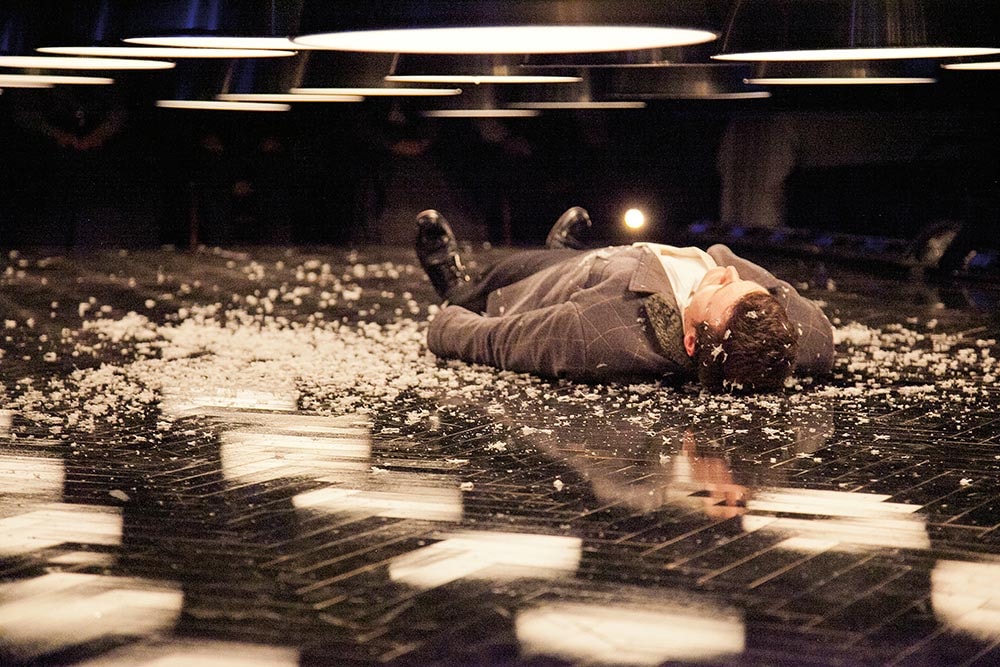
Her affinity for opera is hardly surprising. When I last spoke to Blain-Cruz, she was preparing The Skin of Our Teeth for Lincoln Center Theater, and she referred aptly to her “minimalist maximalist aesthetic, a kind of cleanliness and explosion at the same time,” while Levi Blanco praised her as “a master of curating chaos.” But the ethereal, almost Stranger Things-like netherworld of Lincoln in the Bardo raises the level of difficulty, even beyond Thornton Wilder’s multi-epoch epic. How, for instance, would the production depict what Saunders calls in the book “matterlightblooming,” the spectacular flame-out that characters go through when they’re ready for the next phase of the afterlife? And what about the unsettlingly vivid description of Elise Traynor, a teenaged girl pinned to a fence and intermittently transformed into a grotesque chimera?
“There was a version a couple of years ago where it was going to be all turntables and big moving pieces, and it would take 20 people to move things around,” Blain-Cruz told me after a rehearsal a few weeks ago. Those ambitious set ideas, along with incipient plans to employ holograms, all went by the wayside in conversations with Mazzoli, the composer, and Vavrek, the librettist. The director and writers realized that the goal of the staging should be to make it “feel visceral and alive, and also not too far from the 19th century. It can’t all be a trick. It has to feel like its own universe.” It made sense to call in Ortiz—the versatile puppeteer who built dinosaurs for The Skin of Our Teeth and made and performed Rocky in the film Project Hail Mary—to help create “a kind of tactile universe” for the opera. She also brought in illusion and special effects designer Jeremy A. Chernick.
The challenges of this particular work aside, one big difference between directing opera and directing a play, or even a book musical, is that opera’s non-stop music fundamentally changes the job description. Pacing? That’s the conductor’s lookout (in this case, Yannick Nézet-Séguin). Acting? The singers are doing a version of that, certainly, but it is both enhanced and constrained by their interpretation of the music. Blocking? Choreography aside, the performers’ movement is usually determined as much by matters of vocal production as by realistic behavior.
In short, time and space both operate differently in an opera than they do in a play. How has Blain-Cruz thought about this challenge?
“When you’re reading a play, you’re getting a sense of the rhythm of the play, and then you have the space in between,” she said. “Some playwrights require the momentum to keep going, and some, like Alice Birch, give me permission to do what I want to do.” (Blain-Cruz has directed Birch’s Revolt. She Said. Revolt Again. and Anatomy of Suicide.) The bottom line, she said: “The score is just another text. So the intonations are already determined because the notes give you a certain kind of line reading.”
Digging deeper, she said, it’s possible to work with singers “to understand the intention behind the notes, not just the language.” She cited an example in which Lincoln repeats the words “Little jacket,” referring to the bittersweet memory of his son trying on his first suit. It’s written to be sung three times in an insistent baritone, raising questions for the performer, Blain-Cruz said, not all that far from what they would be asking of a similar scene in a play. “Am I crazy? Am I losing my mind? Is it grief? Am I breaking? Those become the director’s questions with actors,” Blain-Cruz siad. “What’s the intention that’s happening inside of that moment?”
More broadly, she said, she’s found room within the music to explore nuances. “Is it anger that’s fueling the forte? Am I fighting with God or am I beating myself up?” she offered by way of example. “Even though it’s the same notes at the same volume, how that plays reads differently in the voice depending on the performer’s intention.”
All this sound and fury, of course, is signifying a stirringly odd tale of grief, regret, and a kind of tragic wisdom, as enacted not only by the still-living (though not for long) Lincoln but by the opera’s three main characters, who both narrate and live inside the action: a priapic printer, Vollman (Ryan McKinny); a sensitive romantic, Bevins (Jonah Hoskins); and the avuncular but fussy Reverend (Christine Goerke). Also pivotal is an enslaved man, Thomas Havens, who sings powerfully about the indignities of his life, and later mind-melds prophetically with Lincoln’s conscience.
As Blain-Cruz explained, at the center of Lincoln in the Bardo are “a father who’s lost his son and is grieving, and a child lost in this liminal space, who feels tied to his father, and so hasn’t been able to transition.” In addition to the lesson such personal loss may teach us about the preciousness of our time on earth with our loved ones, there’s also the sense, true to Saunders’s book, that this untimely loss, which Lincoln experienced just as Civil War death tolls began to rise, somehow helped him to “understand on a deeper level the loss and the pain that was happening in the country at the time, both for the soldiers and for enslaved people. Grief and love are intertwined.”
Since she’s staging a work all about the afterlife, I thought it was fair game to ask what Blain-Cruz thinks happens when we die.
“I’m an immortal—what are you talking about?” she said, with mock hauteur. Speaking seriously, she said, “I think every piece you work on asks something of you. With this one, I was like: I’m afraid of death, but I’ve got to actually look at it. I’ve got to deal with that. That’s scary. I can intellectualize about it. But when you think about a child dying—just immediately my heart breaks open, and I can’t think. It’s hard for me to imagine a universe where innocence doesn’t have an opportunity to exist again.”
Recalling her Catholic upbringing, Blain-Cruz said, “I was the kid who was like, ‘Mary, I love you so much, but don’t manifest for me. I can’t take a vision! I feel you. I don’t need to see you.’”
There is one place, however, where she welcomes visions and visitations.
“I think theatre is one of the few places that actually helps us access that,” she said, recalling her staging of The Death of the Last Black Man in the Whole Entire World at the Signature Theatre in 2016. “That was one of those shows for me where I was like, ‘Okay, we’re channeling.’ That was Suzan-Lori Parks putting spells on pages.”
She feels similarly about Mazzoli and Vavrek’s work on Lincoln in the Bardo, and about working on operas in general. “This is also like channeling. It is kind of like a vortex.”
Rob Weinert-Kendt is editor-in-chief of American Theatre.