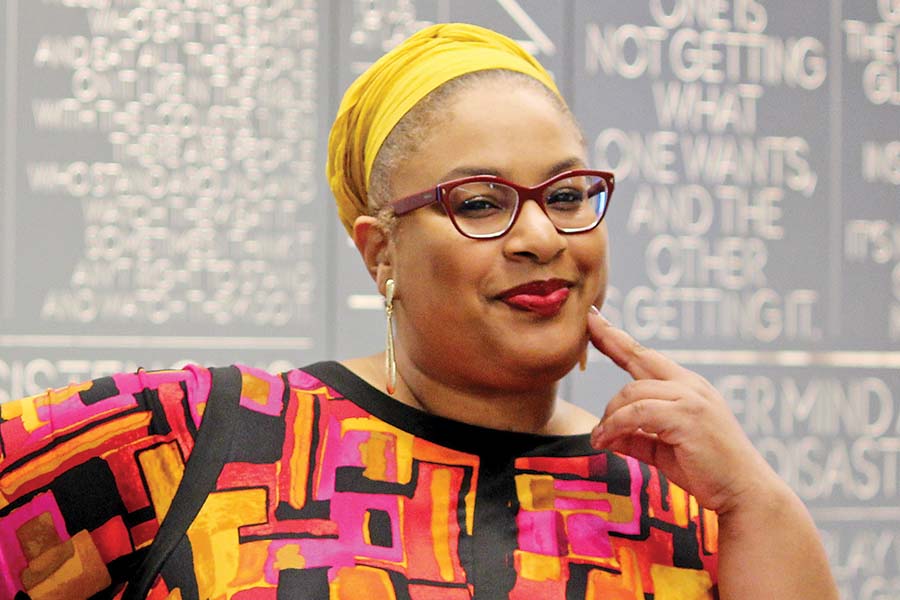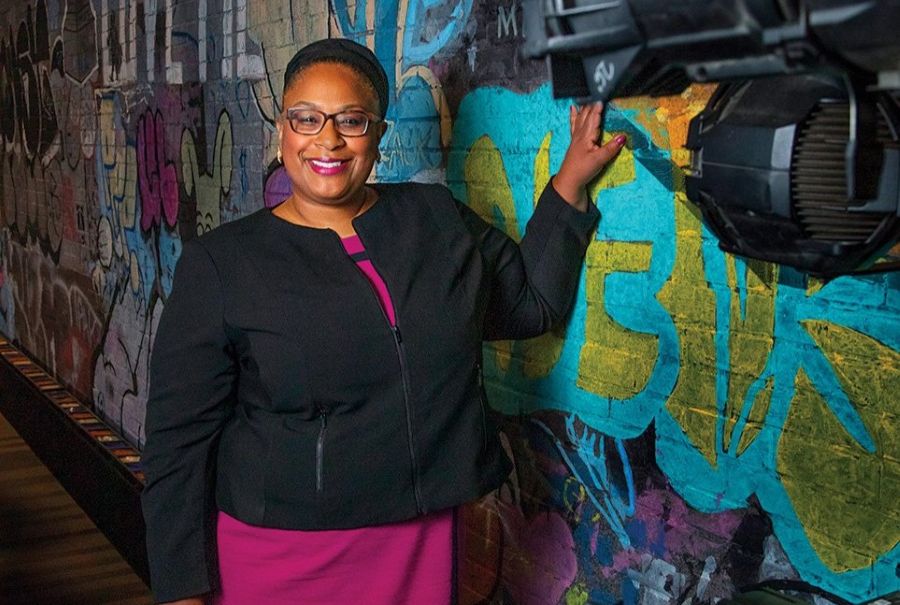
When Hana S. Sharif was hired as the fourth artistic director of Washington, D.C.’s Arena Stage in April 2023, she told American Theatre it was a job she’d aspired to since she was 19, adding, “I look at this moment with great humility and great responsibility and great excitement about being part of the natural evolution of a theatre company that has been fully committed to elevating and reflecting our evolving humanity. I also think about this institution, which has had three wonderful artistic directors, but in particular 65 years of women’s leadership—it is again an honor and a gift to continue that legacy.”
Now, barely three years into that dream job, Sharif has made her exit. On June 26, she sent a resignation letter to Arena’s board of trustees, saying that she and the board had “arrived at a crossroads—one defined not by a lack of shared love for this institution, but by differing visions for how Arena Stage should meet the future: what art belongs at its center, how its teams should be built and empowered to evolve, and what a sustainable path forward truly requires.” That same day, The New York Times published news of the resignation, ahead of the opening of the TLC jukebox musical CrazySexyCool.
In the weeks since, sharply diverging reports have emerged from current and former staff and associates about Sharif’s time at Arena. Many colleagues rallied to her side on social media, testifying to her brilliance and vision, and questioning what looked to them like the forced ouster of the theatre’s first artistic director of color, at an organization that bears the distinction of having been co-founded by Zelda Fichandler in 1950 as the first racially integrated theatre in D.C. Some of these voices were also cited in a series of reported pieces published last week—alongside a number of allegations from staff and colleagues about stressful working conditions and serious management concerns at Arena during Sharif’s tenure.
So what happened at this flagship American theatre? And what does it mean, not only for the D.C. theatre scene, but for the national theatre field at a moment of precarity and contraction? Taking Sharif’s own list of sticking points in turn: There were conflicts over programming (“what art belongs”), working conditions (“how its teams should be built”), and finances (“a sustainable path forward”). One factor Sharif didn’t mention, but which many would name as central: racist and sexist resistance to her leadership as a Black woman. Even so, between others’ and our own reporting, we can identify no clear single cause or “last straw” that led to this final breakup between Sharif and the Arena board, and neither would speak to us for this article. What is clear is that the industry is watching as this story unfolds for lessons about the often fraught relationship among executive leadership, staff, and boards at American theatres.
While there was excitement about her historic hiring—and even many of her detractors laud her ability to articulate a vision and fire up a room—Sharif also faced some immediate pushback. One former sales staffer told us that they received complaints from patrons about the choice of shows in the 2023-24 season, and had to explain that these had been programmed by Sharif’s predecessor, Molly Smith. Many former staff members acknowledged to American Theatre that any transition between artistic directors has its growing pains, so they were willing to push through setbacks like a long-delayed 2024-5 season announcement.
In that season, the first that Sharif programmed, the theatre had both successes (Jaja’s African Hair Braiding) and setbacks (Death on the Nile and The Other Americans were plagued by design and budget conflicts). And the idea to hold actual weddings onstage after Tarell Alvin McCraney’s We Are Gathered was criticized by some on the Arena staff as a lovely idea in principle, but poorly executed in practice.
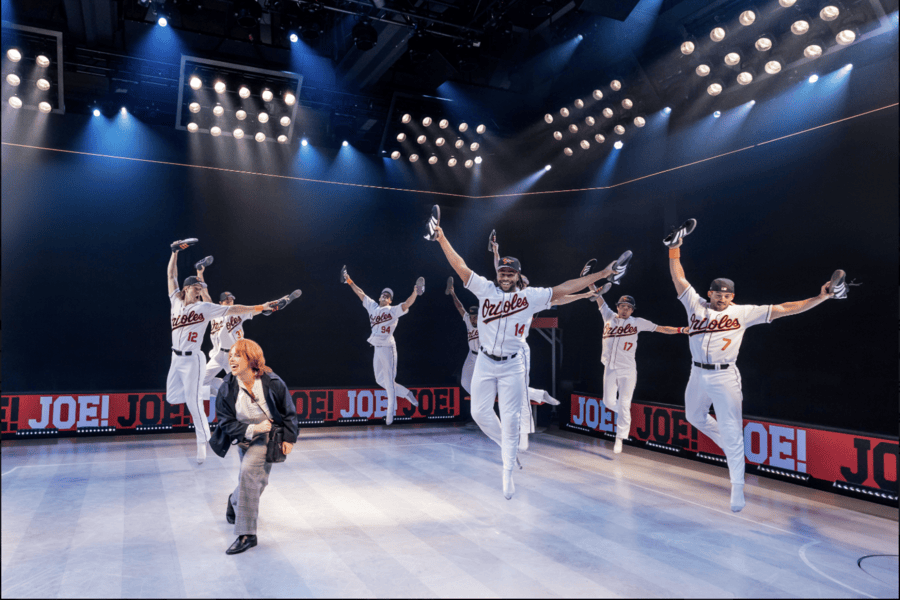
The 2024-25 season included commercially enhanced musicals (Sarah Silverman’s The Bedwetter and the world premiere of Lauren Yee and Heather Christian’s adaptation of A Wrinkle in Time). The 2025-26 season went even further, including a Broadway-bound revisal of Damn Yankees, Savion Glover’s Rodgers & Hart retake Chez Joey, and the currently running CrazySexyCool. This was a marked contrast from Arena Stage’s previous seasons, which included commercially enhanced productions less frequently. Earlier this year, Sharif brought on Darren Edward Johnston, a commercial producer, as an associate artistic director of commercial strategy and partnership.
While these moves brought a new level of attention (and revenue potential) to Arena productions, as they do at other similarly resourced regional theatres, they also reportedly put strain on staff to meet newly elevated expectations. Said one staffer for a commercially enhanced production, “Hana wanted Arena to be doing Broadway-level productions, which is a fine aspiration, but that’s an infrastructure that takes decades to build, and she wanted it overnight…She would just kind of push and push and push.” Others told us that Sharif had no alternative but to push, because, as one former staffer put it, “I think it was just really hard for people to shift to what it meant to work for someone whose standards were as high as hers.”
One Arena staff member said that these productions pushed technical staffers “to the brink,” adding, “When I would ask them to go above and beyond, they’d already been asked for years to go above and beyond with no payoff.” This dynamic was surely part of the reason that Arena Stage’s production and box office workers formed a union in 2025, advocating for a living wage, healthcare, pensions, and better working conditions. In January of this year, Arena Stage’s backstage production workers voted to join IATSE.
While Arena Stage currently lists two human resources employees, former Arena Stage employees also told American Theatre that there was an inconsistent HR structure during Sharif’s tenure, with an external HR manager at one point coming in once a week. That, combined with high staff turnover, meant that department heads were often tasked with handling workplace issues.
A recurring theme in our (and others’) reporting: What some saw as Sharif’s assets, others saw as liabilities. We heard and read complaints about long hours and late nights, and of staff members reduced to tears. But even many who made these allegations conceded that Sharif herself was often right by their side over those long hours. Raiyon Hunter, Arena’s resident casting director, recalled that Sharif “worked 19-hour days a majority of the time,” adding that some of the theatre’s artistic department remained on the job “for hours after that.”
Likewise, the sense of responsibility Sharif felt—the idea that every detail of Arena’s operations would be a reflection on her leadership—manifested to some as admirable accountability, and to others as self-involvement. “Every decision there was about her,” said one former staffer. “It’s like, no, it’s about the institution. The theatre has to be bigger than one person.”
Some reports have cited the theatre’s current $1.8 million deficit as a point of concern, though publicly available 990s make clear that in the year before Sharif began, 2022, the theatre ran an even larger deficit, and has run surpluses in all the intervening years. As management consultant Al Heartley pointed out in a Substack post, Arena took out a $60 million loan in 2018, and has been negotiating to pay that off since—surely a source of overhanging financial stress. In any case, it’s not clear why economic pressures (or blame) would fall entirely on Sharif’s shoulders, when Arena’s executive producer, Edgar Dobie, has shared equal power and responsibility with her (and is currently the theatre’s sole leader, as the board plans to kick off a new artistic director search in the fall).

Still, for many, the reason for Sharif’s departure, and the message it sends, is unmistakable: America’s most well-resourced theatres have a problem recruiting and retaining artistic leaders of color. In 2023, American Theatre wrote about a cohort of new leaders of color at U.S. theatres, none of whom currently retain the positions they did at the time. Even when that story was published, one of those artistic leaders, Nataki Garrett, had already parted ways with Oregon Shakespeare Festival, where she had had a rocky three-and-half-year tenure, facing not only the Covid lockdown and financial pressures but racist incidents in Ashland and what she described as resistance from OSF’s board.
“I have not led in a theatre where people were not surprised when I was giving the directives,” said Garrett, who made her feelings about Sharif’s resignation clear in an impassioned Substack post. “When you run a business you provide leadership and authority and directives with clarity about what it is we’re all pointing to, or the goal, right?” But according to Garrett, whenever she acted assertively as a leader, she was met with confusion that “would show up in the form of pushback, or would show up in the claim that I had been mean.” Her bottom line: “In this country, the practice is that Black women are not supposed to lead, we’re not supposed to tell you what to do—we’re supposed to nurture you through it. Somebody else is supposed to tell you what to do.”
She also situated Sharif’s departure in the context of a kind of recession for Black women workers, particularly in Washington, D.C., that is symptomatic of the Trump administration’s anti-DEI backlash. “We’re in a climate where 350,000 Black women have lost their jobs in less than 12 months,” Garrett said. “Almost every Black woman who was in a government office is out of work.” Meanwhile, according to the Bureau of Labor Statistics, while the U.S. unemployment rate is 4.2 percent, Black unemployment is 6.6 percent—the highest it’s been since Covid-19.
What does Sharif’s departure mean for the American theatre field writ large? In a Substack post, Kelvin Dinkins Jr.—who until a year ago was executive director of American Repertory Theater—wrote about what he sees as “a revolving door” of leaders of color who aren’t given the support or tools they need to succeed in an acutely challenging business. “In the past decade,” Dinkins wrote, “a wave of new Black executive leaders arrived at predominantly white institutions only to inherit escalated financial instability, entrenched governance problems, increased staff turnover, and cultures fundamentally resistant to change. The hires are celebrated as historic appointments, then expected to almost instantly repair years of institutional neglect while navigating one of the greatest collective operational crises since the regional theatre movement started.”
For Tom O’Connor, founder and CEO of TOC Arts Partners, who has led many executive artistic searches and strategic plans at major theatres (though never for Arena), a moment like this offers a chance for reflection on the prevailing system of theatre governance.
“Upstream of any situation where a board and executive leader find themselves out of alignment are the vision and values conversations that we do as organizations during a strategic planning process,” said O’Connor, who also serves on nonprofit boards himself. “What this moment shows is that the decisions that are made in those processes actually have teeth. There is actually a larger conversation to be had now, in 2026, about what everybody’s role is in setting the vision and the course for an organization.” Leadership transitions, he said, are “nothing shy of a major change management project. We sometimes think about it as: This person comes in and they’re a success or they’re not. But it’s a much broader conversation than that: How are we supporting every party within that transition?”
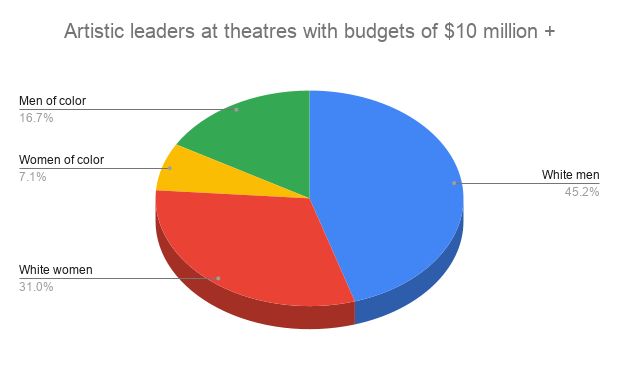
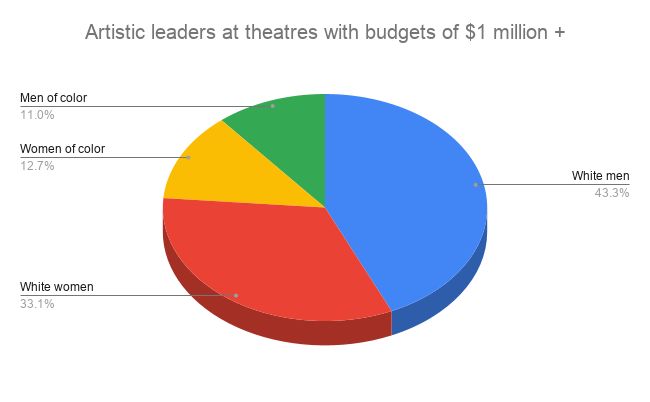
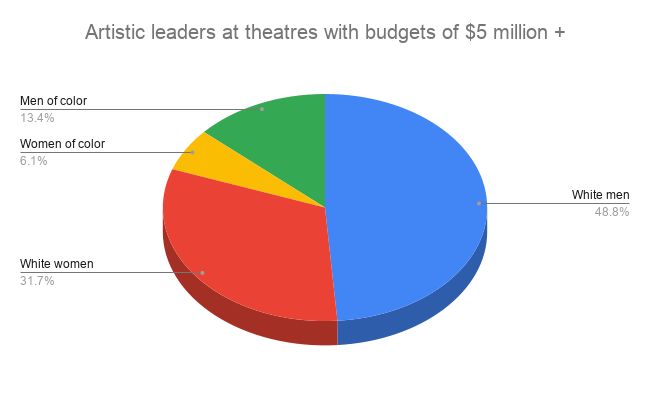
To gauge the field’s progress on diversity in executive hiring, American Theatre looked at the demographics for artistic directors at U.S. theatres at various budget sizes. The statistics show that as the budgets get larger, the theatre leaders are less likely to be women of color: At theatres with budgets over $1 million (a pool of 236 theatres), we counted 105 white male artistic directors, 81 white women, 27 men of color, and 31 women of color. (Of those 58 leaders of color, it should be noted, 12 lead explicitly defined theatres of color rather than predominantly white institutions.) At theatres over $5 million (a pool of 83 theatres, none of which include theatres of color), we counted 41 white men, 25 white women, 13 men of color, and 5 women of color. And at theatres with budgets over $10 million (a pool of 43 theatres), we found 20 white men, 13 white women, 8 men of color, and 3 women of color. (See charts below.)
If we ratchet up to an even higher budget tier, it’s notable that two Black women who singularly lead theatres above the $20 million mark—Garrett at OSF and Sharif at Arena—had such short tenures. One exception is Tinashe Kajese-Bolden, one of two artistic directors at Atlanta’s Alliance Theatre, who is now in that bracket (she’s one of the three women of color mentioned in the $10-million-plus cohort above).