When was the first time you were called “dramatic”? I treasured the word as a toddler. “Dramática. Uma pequena Fernanda Montenegro,” my grandmother Alys would say, referencing the famous Brazilian performer.
I don’t remember the word “too” preceding “dramatic” until I was around 6 in the U.S. My classmates cast care—the deep furrow in brow, love in eyes, my very spirit—as too dramatic, too nice, too emotional, too loud, too ethnic, too tall. Such words strive to shrink what I’ve come to understand as a superpower. If one is “too much,” there must be some agreed-upon frame of reference, no? But what is that limiting standard? And why would one want to enforce it, to curb humanness?
Theatre resists that very limitation—expands our capacities to feel, express, and understand our lives and differences. Even as the constant onslaught of digital media numbs deeper feeling, I hope young people won’t be further deterred from “dramatics.” I hope the future won’t further write off hypersensitivity, that gift required of theatremakers that so inspires audiences, as “too much.” I hope that they will step to the plate. Own an artist’s way. Embrace crying during shows for young audiences and charting their own affective dramaturgies.
I’m not alone in lamenting critiques of “muchness.” Even Cynthia Erivo, a theatrical savior from Jesus in Jesus Christ Superstar to Elphaba in the stunning Wicked movies, titled her newly published book Simply More: A Book for Anyone Who Has Been Told They’re Too Much. In the past few weeks I’ve listened to how other artists have unlearned this label in order to grow into their power, from seasoned professional directors to high school-aged writers.
This new column is dedicated to those readers who resist the stifling of spirit and fill the gaps in a grieving society. The creative kids, grown and dreaming, who weep in the darkened house and strive to walk weary yellow roads in others’ shoes.
“I’ve always felt and taken on other people’s energy,” said Nicole Brewer to me over the phone. The founder of Anti-Racist Theatre and director recently closed Julius X, a reimagined tragedy by Al Letson, at the Folger Theatre in Washington, D.C. Brewer sees theatre as an opportunity not to bear witness but also to invite active participation within a story and beyond. In this production, she featured an altar onstage, paying homage to the practice of street altars and allowing audience members to acknowledge their grief.
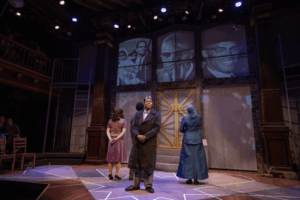
“We were not asking for voyeurism in this production, but participation, and to have audiences onstage for us to hold onto energy, legacy, and memory in a tangible sense. We’re building that,” said Brewer. When she was younger, she said, she felt disconnected from the African practices of altars and didn’t get to reclaim them until she was an adult. “They exist in terms of deep, deep spirituality and connection,” said Brewer.
Today, hers is a leading voice in championing deep connection through storytelling. Yet that same powerful intentionality and sensibility were deemed “too much” from a young age. Brewer remembers hearing the critique “from the moment I could understand the expression,” she said. “It was how dramatic I was, or talkative.” She credits her deep listening today with the survival tactics she developed early on.
Today, she not only fights to hear the chords that stand out, but to amplify them. Cognizant of “the words I have left as a human,” as she put it, she spoke of sharing stories in spiritual and communal terms, emphasizing the need to both speak and listen with care.
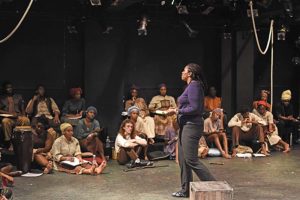
One practice she invokes in rehearsals is an Àṣẹ circle, an exercise she learned at Howard University in which people come together and create a healing sound circle. Each body listens for what is needed and, one by one, contributes a rhythmic sound. “If you aren’t listening,” she said, “it fails. It’s the same for theatre. If we come closed, unreceptive, unwilling to listen, then we leave the same. Theatre teaches us, when the invitation is there for us to show up as all of who we are, how to be more in tune with one another.”
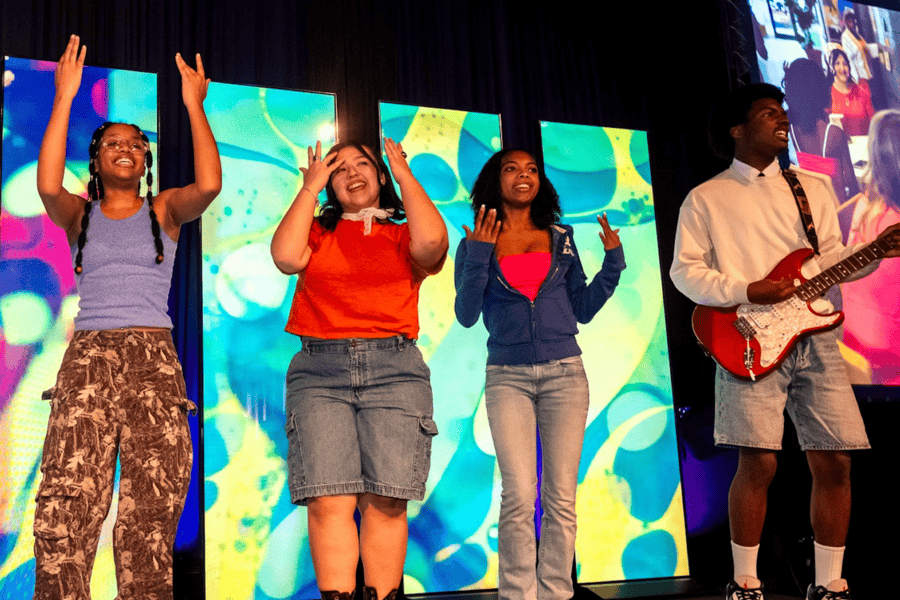
As a member of Collaboraction’s youth ensemble The Light, Zoe Lopez, 18, is flipping the script on “muchness,” already harnessing her ability to speak truth to power. I had the opportunity to meet her and fellow teen artists at Collaboraction’s “No Place Like Home” Utopian Ball in Chicago. Their mentors include Cheryl Lynn Bruce, Darlene Jackson, Anthony Moseley, Antonio Mendoza, and Sandra Delgado—Chicago luminaries who affirm the students’ unique gifts. The young artists meet once per week in April and May, twice per week in June, three to four times per week in July, and perform throughout the year.
“In elementary and middle school I always had something to say, and everyone would point that out or say things like, ‘Keep your thoughts to yourself,’” said Lopez of the time before she could become more deeply involved in theatre. At a point in middle school, she said, “I would just be quiet.”
That all changed when she began attending Chicago High School for the Arts and participating in The Light, designed for youth between the ages of 14 and 18 to explore live performance as a vehicle of social justice. Said Lopez, “I realized my voice could speak for others. I found that it’s not that I was too much, I just wasn’t speaking to the right audience. Finding that group of people has been important.”
One student is creatively investigating women’s safety on public transportation. “I’m very passionate about the topic,” said 16-year-old Lucy De Maio. She said she feels free expressing herself in the program because, she reasoned, “No one is going to judge you for exploring what it means to be a human.”
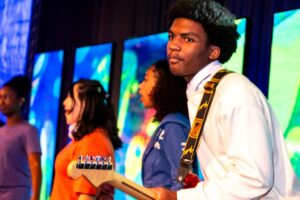
Musician Kristian Mitchell, 18, has also grown into his own with the group, helping write and record The Light’s stunning theme song. A pro at guitar, he said he realized there are not only many causes to appreciate and better understand, but many ways to speak up on them. “You can strum a few chords, and that’s truth. That’s what I bring,” he said.
The Light not only nurtures young talent in a welcoming environment; it also pays them to do so. That’s one thing Montiara Davis, 19, especially appreciates about the program. Said Davis, “I found a place and community where I can create my art safely, be pushed, and be more vulnerable. I can continue to be financially supported, but also be able to pursue my dreams.”
The Collaboraction event as a whole buzzed with excitement, as the organization has built a brand new “House of Belonging” space in Humboldt Park, where Frank L. Baum happened to live when he wrote The Wizard of Oz. The official opening event will be celebrated in the new year. Chief executive officer Darlene Jackson drew Ozian parallels for the 2025 cohort of young artists, saying, “They really did find the end of the rainbow.”
Jackson feels passionate about focusing on the moment, the here and now, and the people in her community. “We have kids of all abilities, and we are all together,” she said. “Whatever our creative practices are as educators, we are aging out. If you don’t give it back, where does it go?” The students have performed at high-profile events like Lollapalooza and the DNC, but what she’s most proud of is the safe space Collaboraction fosters for youth to grow. The hope is for even more cities and other professional organizations to invest in youth artivists.
Indeed, creating spaces “where people of all minorities, ages, and passions can come together and feel safe is very, very difficult right now,” as Zoe Lopez put it. Collaboraction and the artists affiliated are working overtime to dream up such places.
Sandra Delgado wants to fill in the torn pages of history. She draws inspiration from real events in Chicago, with a particular emphasis on Latine immigrant and first-generation communities. Her most recent work Hundreds and Hundreds of Stars ran through Nov. 9 with TimeLine Theatre Company, and her new solo show LIVE. LOVE. NOW. is currently in development with Collaboraction.
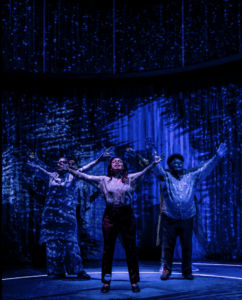
TimeLine, like Collaboraction, seeks to lift up locals’ spirits with art that speaks directly to Chicago. Coincidentally, both theatres are opening new homes. “I really want this new space to be good for the community,” said TimeLine artistic director PJ Powers to me on a fall day amid tech. The five-story theatre is only set to open in the new year, so Hundreds and Hundreds of Stars captured audiences’ imaginations within Lookingglass’s space instead.
I hurried into the historic Water Tower location from my home a few weeks ago to speak with Delgado and director Kimberly Senior during a difficult moment for Chicago. The play centers motherhood and migration, and though the idea came to Delgado years ago when she was listening to the radio, the script resonated in a very immediate way this fall.
The play follows a mother as her legal status is jeopardized on a technicality (minor weed charges from years ago), in spite of her being in the U.S. legally since she was a child. Delgado said she hopes her work offers “places to process the hard stuff, especially when it’s happening right outside,” as she put it.
Delgado and Senior said they viewed the 90-minute Hundreds and Hundreds of Stars as the first act.

“What happens after you see this play,” said Senior, “is the second act.” Senior and Delgado expressed an eagerness for audience members to feel moved to action, be it large or small. Fortunately, they also had exceptional dramaturgy in Yasmin Zacaria Mikhaiel, who supported the company through the new play development process, and Anna Rogelio Joaquin, who focused on the history of immigration policy and provided “Take Action” materials in response to citywide raids. The pair also collaborated on an interactive display, empowering folks to continue the conversation in the lobby and cement this “second act” of engagement.
What I found particularly beautiful interacting with these artists is their collaborative foundation, built on friendship and mutual respect. Zacaria Mikhaiel and Joaquin have long corresponded and collaborated; Delgado and Senior have been friends for years and had their kids around the same time; and the warmth around choreographer Raquel Torre and assistant director Natalie Friedman felt infectious. The artists spoke joyfully of one another, as well as the story they came together to tell.
Delgado and Senior shared many hopes for the rehearsal room, Chicago, and the world. One hope they emphasized is to make their kids proud. “This is the generational wealth I can give,” said Senior. “Integrity.” Between Collaboraction and TimeLine’s work in Chicago, I found it in me to muster hope for youth and future.
In a previous column, I asked readers to share what they crave within our coverage (you can still do so here!) and a few requests involved writing prompts. Here is one Fornesian exercise courtesy of the prolific Migdalia Cruz.

A taste of what a workshop with the legendary María Irene Fornés felt like, this exercise has been adapted and led by Cruz at the Actors Center. “I studied with Irene for about five years,” Cruz said, “so I could share this with you. To participate, all you have to do is open your hearts and your viscera, and write.”
Align desks to touch in a sacred circle, or a chain of squares. Get paper and pen ready. Appoint a writer-facilitator to speak the following words, courtesy of Cruz, who emphasizes the Fornés Method’s oral tradition that “flows through the leader,” shifting with each prism of spirit and experience while “acknowledging the original pedagogy from whence it came.” Give yourself four hours.
Where do we find a place to see the heart and express it, unapologetically “dramática”? What is the one golden pathway or theatremaking technique toward healing? Where is the country you once knew? The Wizard of Oz’s original “no place like home” refrain that preceded Wicked’s desperate cry, “Something bad is happening in Oz?”
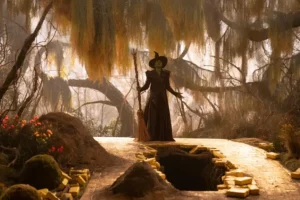
Cynthia Erivo takes a pause between “no place” and “like home” in Wicked: For Good’s new song “No Place Like Home” (written by Stephen Schwartz with Erivo). But sometimes we don’t reach those notes—that feeling of home.
Sometimes there is no place. Concrete and whole, guaranteed to hold uncompromising freedom and universal belonging. Any clear concept of home felt flimsy, slippery from the time my spirit straddled continents. I never saw a yellow brick road. All that glittered was not gold.
Some people spend their whole lives looking. But I’ve been realizing, through theatre artists and their airborne melodies and handmade visions, that home is in the art and the fight. Home is in the process of building and sustaining myth and dream—made possible not by one clear, real, yellow place, but your own intangible imagination, that patchworked island of hopes and woes that keeps you alive.
Your muchness builds much. So long as you continue creating, there’s no place like you.
Gabriela Furtado Coutinho (she/ela/ella) is the digital editor of American Theatre, and a Chicago-based actor, playwright, and poet.